
This is where we explore the contribution economy of meet.coop, and how to map it.
We are seeking to map the contributions that make meet.coop work, together with the forms of recognition (including payments of compensation) given to contributors by the commons. We approach this as a matter of contributions in commons, as distinct from - and in opposition to - exchanges in capitalist markets.
Commons vs market is one of the the inbuilt and intentional tensions for the coop. Maps of contributions are one of the means we aim to deploy, in recognising and handling the tensions.
Here's a basic schema of contributions in commons.
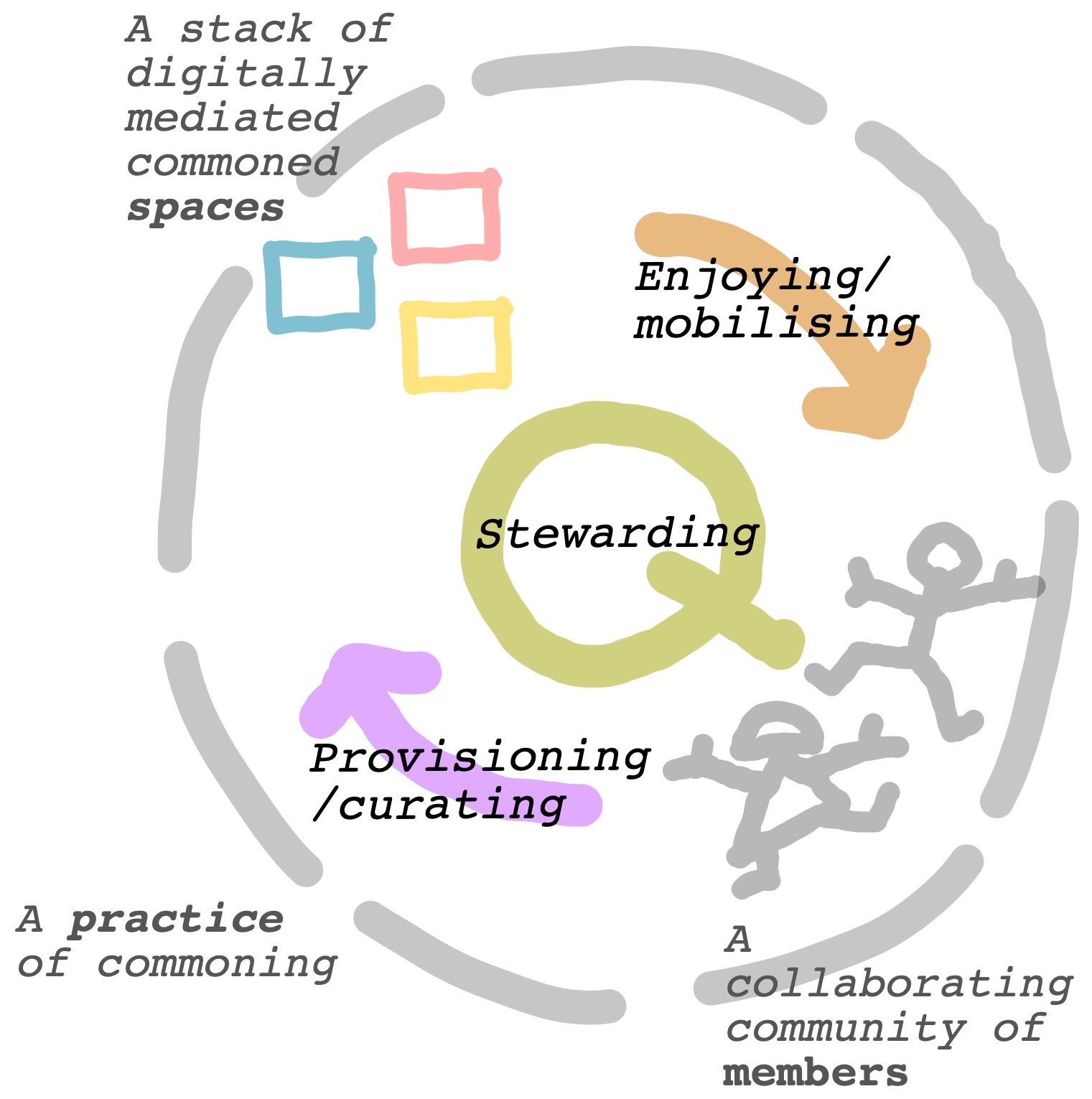
Contrubutions in a commons
See Commoning
# Political. Economy. What we're addressing here is 'an economy' because the provisioning and mobilising of means of subsistence, livelihood and wellbeing are centrally involved: payments for work performed, allocations of capacity, access to material means (server capacity, codebases, platforms, etc), basic means of cultural and economic organising and communication, digital infrastructures underpinning other sectors of the coop-commons economy. Etc.
It's 'political' because the relationships between contributors and contributions are critical, and need to be established as different from the social relations that typically organise an economy . .
- In the economic dimension: wage work, private ownership of significant means, commodity exchange, accumulation of capital.
- In cultural and aesthetic dimensions: patriarchy and gendered divisions of labour and recognition; white supremacy and systematic marginalising, domination and impoverishment of people of colour; colonialism and global uneven development across hemispheres, nations and regions.
These systematic and intentional alterations of social relations within the commons all are matters of power, and commoning is a strategy of Dual power.
In this wiki we set out a Basic vocabulary of terms for handling an economy of contributions. We tag the terms with visual icons so that relationships within the political economy of contributions may be visually displayed.
# Follow the links
DOT FROM preview-next-diagram STATIC strict digraph { rankdir=LR node [style=filled fillcolor=lightyellow] "mh graph snippets" node [style=filled fillcolor=lightblue] node [style=filled fillcolor=white] "mh graph snippets" -> "foobar" "mh graph snippets" -> "foobar2" "mh graph snippets" -> "foobar3" "mh graph snippets" -> "Preview next diagram" "mh graph snippets" -> "Pattern Cluster Diagram" "mh graph snippets" -> "Copy Ward's Dynamic Diagram" "mh graph snippets" -> "2021-05-02 Revisit Graphviz Thing" "mh graph snippets" -> "Somewhere" "mh graph snippets" -> "Upstream" "mh graph snippets" -> "Elsewhere" "mh graph snippets" -> "Downstream" "mh graph snippets" -> "Source" "mh graph snippets" -> "Sink" "mh graph snippets" -> "Relationship" "mh graph snippets" -> "Appreciation" "mh graph snippets" -> "Breaking Bread Together" "mh graph snippets" -> "Celebrate" "mh graph snippets" -> "Good Faith Assumptions" "mh graph snippets" -> "Honour Each Person" "mh graph snippets" -> "AN Other" "mh graph snippets" -> "Growing Regions as Hypertext" "foobar" "foobar" -> "son of foobar" "Preview next diagram" "Preview next diagram" -> "Agile" "Preview next diagram" -> "Hero's Journey" "Preview next diagram" -> "Dayton's Story" "Pattern Cluster Diagram" "Pattern Cluster Diagram" -> "Land Tenure" "Pattern Cluster Diagram" -> "Utilities First" "Pattern Cluster Diagram" -> "Data With The People" "Pattern Cluster Diagram" -> "Incremental Self-Build" "Copy Ward's Dynamic Diagram" "Copy Ward's Dynamic Diagram" -> "mh graph snippets" "Copy Ward's Dynamic Diagram" -> "Books" "Relationship" "Relationship" -> "Appreciation" "Relationship" -> "Breaking Bread Together" "Relationship" -> "Celebrate" "Relationship" -> "Good Faith Assumptions" "Relationship" -> "Honour Each Person" "Relationship" -> "Hosting" "Relationship" -> "Power Shift" "Relationship" -> "Shared Airtime" "Relationship" -> "Tend Relationships" "Relationship" -> "Transparency" "Relationship" -> "Categories"}